

AgRadiance AgRadiance

From Complexity to Approval

Independent agricultural performance and risk analysis for agrivoltaic projects.

  • Crop modelling
  • Design optimisation
  • Permitting evidence
  • Agricultural due diligence

Track record

Studies for developers of utility-scale agrivoltaic projects. Aggregate figures only: we do not name clients without their consent.

Projects modelled
9
MWp assessed
500+
Countries
5
Crops in our toolset
80+
each with field data on shade response
Field observations in our evidence base
4222
from 762 published studies

How clients use us

Delivered as

Quick Scan

Site or portfolio screening: agronomic, environmental and regulatory fit, red flags, and high-level PV and crop yield context, on one method across every site. Ends with a go / no-go brief per site.

Delivery
2 business days
Best for
One site or a whole portfolio
Ask about this study

Delivered as

Technical Analysis Core study

Coupled light, microclimate, soil water and crop simulation for one site and layout; multiple weather years, rainfed and irrigated; PV yield and LER; signed report.

Delivery
Preliminary results within 1 week; report 2–3 weeks after input data
Best for
Due diligence and design decisions
Ask about this study

Delivered as

Feasibility, Risk & Permitting

The Technical Analysis plus risk assessment, an agrivoltaic use concept, design optimisation and the authority package.

Delivery
Agreed per project
Best for
Projects going to permit
Ask about this study

Delivered as

Technical Analysis Core study

Coupled light, microclimate, soil water and crop simulation for one site and layout; multiple weather years, rainfed and irrigated; PV yield and LER; signed report.

Delivery
Preliminary results within 1 week; report 2–3 weeks after input data
Best for
Due diligence and design decisions
Ask about this study

Delivered as

Monitoring & Data Management

Yield, light, microclimate and soil-water data from the operating site: collected, quality-checked, stored and reported each season against the modelled baseline and the monitoring the permit requires.

Delivery
Each season, during operation
Best for
Operating projects with monitoring duties
Ask about this study

Does the crop keep its yield under the array?

We model what your crop keeps under a proposed PV array: light, microclimate, soil water and growth, solved together on your site. The result is a report an authority can review.

One field, open and under a single-axis tracker array Cross-section of a wheat field. On one side of the line the field is open; on the other, single-axis trackers at 9.5 m pitch and 3.2 m axis height shade the crop. The wheat comes from our plant model, grown at the light each position receives: 1.03 m tall in the open field, 0.66 m under the modules and 0.91 m between the rows. Below the crop, two bars show annual light at crop height, 58 to 83 % of the open field, and soil moisture in the top metre during grain filling, wettest at the module edges where rain runs off. 3.2 m axis 4.75 m, half the pitch Winter wheat, 1.03 m 0.66 m 0.91 m Annual light at crop height Soil moisture, top metre, grain filling Annual light at crop height Soil moisture, top metre, grain filling

Open field

The reference every result is measured against.

Light at crop height
100 %
Wheat yield
100 %
Crop height
1.03 m
Soil water
36.6 %
Leaf temperature on hot days
38.6 °C

Under the array

Between the rows

Light at crop heightof the open field, annual
78 %
Wheat yieldof the open field, median year
104 %
Crop heightfully grown
0.87 m
Soil waterby volume, top metre, grain filling
36.0 %
Leaf temperature on hot days3.0 °C cooler than in the open field
35.6 °C

Illustrative example · typical ranges, not project results

Share of open-field yield under the array

  • Lettuce P10 85 %, P90 104 % 95 %
  • Spinach P10 83 %, P90 102 % 93 %
  • Pasture P10 77 %, P90 98 % 88 %
  • Barley P10 77 %, P90 97 % 87 %
  • Wheat P10 75 %, P90 97 % 86 %
  • Potato P10 72 %, P90 94 % 83 %
  • Soybean P10 69 %, P90 92 % 81 %
  • Maize P10 60 %, P90 85 % 73 %
  • Median across weather years
  • P10–P90
  • DIN SPEC 91434 minimum, 66 %
  • Open field
Land equivalent ratio
1.62
crop and electricity from the same land
Wheat yield
86 %
of the open field, median of twenty seasons
Irrigation demand
−25 %
compared with the open field
Electricity
54 GWh
a year from the same land

Coupled models, solved point by point

Light, microclimate, soil water and crop growth run on the project's own geometry, weather, soil and crop calendar, across the pitch and hour by hour.

Tracker rows in 3D with the ground coloured by annual light: darker under each row, brighter between the rows
Annual light at crop height, % of the open field50 %100 %
  1. Light

    Ray tracing of the array, hour by hour

  2. Microclimate

    Leaf and soil temperature, humidity and wind

  3. Soil water

    Rain, evaporation and roots, down to 2 m

  4. Crop growth

    Yield per zone, over many seasons

  5. Operations / farmability

    Machinery passage and headland turns

Read the full method

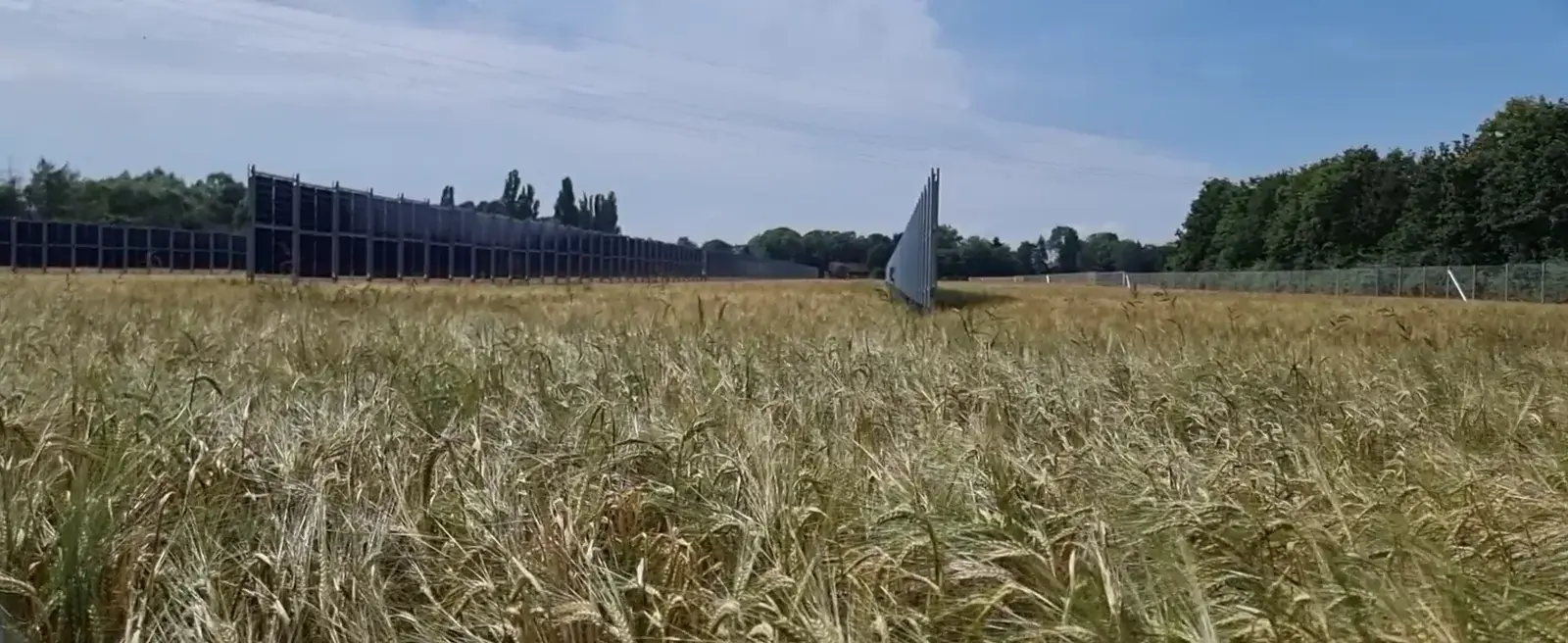
Overhead single-axis tracker array above a barley field

Energy systems and agronomy, in one team

AgRadiance was founded in 2025 by two engineers, one from each side of the field.

Constantin Klyk

Constantin Klyk

Energy systems engineer · Co-founder

8+ years of experience across agrivoltaics, PV system modelling and project development. Previously led agri-PV project development at Zimmermann PV-Steel Group and was a research engineer at ISC Konstanz, specialising in PV performance and yield prediction. Lead author of the field's first comprehensive textbook on agrivoltaics, published by the IET and written with 32 experts from 9 countries.

Jorrit Becking

Jorrit Becking

Agro-environmental systems engineer · Co-founder

7+ years of experience where agrivoltaics, agriculture, climate finance and clean energy meet. Previously Chief Agriculture Officer at Okovate, a U.S. agrivoltaics developer, and before that led climate finance and sustainable agriculture work at the World Bank. Educated at Yale and Wageningen University, with a background in crop science and environmental systems.

Discuss your project or book a call

Tell us about the project and what the results are for: design, permitting, due diligence or financing. We reply within one business day, or propose times for an intro call.

  • Site location or boundary (KML/KMZ)
  • Draft layout: system type, pitch, axis height
  • Crops, rotation and irrigation regime

Or email us directly: info@agradiance.com